<?xml version="1.0" encoding="utf-8"?><feed xmlns="http://www.w3.org/2005/Atom" ><generator uri="https://jekyllrb.com/" version="3.10.0">Jekyll</generator><link href="https://jkhartlaub.com/feed.xml" rel="self" type="application/atom+xml" /><link href="https://jkhartlaub.com/" rel="alternate" type="text/html" /><updated>2026-10-05T13:24:03+02:00</updated><id>https://jkhartlaub.com/feed.xml</id><title type="html">Jonathan Kaspar Hartlaub</title><subtitle>PhD Candidate at the German Aerospace Center (DLR)</subtitle><author><name>Jonathan K. Hartlaub</name><email>contact@jkhartlaub.com</email></author><entry><title type="html">Taste Might Gain Significance in Mathematical Research Due to AI</title><link href="https://jkhartlaub.com/taste-and-ai/" rel="alternate" type="text/html" title="Taste Might Gain Significance in Mathematical Research Due to AI" /><published>2026-05-23T00:00:00+02:00</published><updated>2026-05-23T00:00:00+02:00</updated><id>https://jkhartlaub.com/taste-and-ai</id><content type="html" xml:base="https://jkhartlaub.com/taste-and-ai/"><![CDATA[]]></content><author><name>Jonathan K. Hartlaub</name><email>contact@jkhartlaub.com</email></author><category term="linkedin" /><category term="mathematics" /><category term="ai" /><summary type="html"><![CDATA[OpenAI's announcement of their solution of the unit distance problem and how this might lead to an emphasis on taste over volume in mathematical research, the latter being within reach of LLMs.]]></summary></entry><entry><title type="html">The Friendly Rivalry Between Quantum Computational Methods and Their Classical Counterparts</title><link href="https://jkhartlaub.com/friendly-rivalry/" rel="alternate" type="text/html" title="The Friendly Rivalry Between Quantum Computational Methods and Their Classical Counterparts" /><published>2026-05-17T00:00:00+02:00</published><updated>2026-05-17T00:00:00+02:00</updated><id>https://jkhartlaub.com/friendly-rivalry</id><content type="html" xml:base="https://jkhartlaub.com/friendly-rivalry/"><![CDATA[]]></content><author><name>Jonathan K. Hartlaub</name><email>contact@jkhartlaub.com</email></author><category term="linkedin" /><category term="quantum computing" /><category term="scientific computing" /><summary type="html"><![CDATA[On the competition among researchers to replicate quantum-advantage results on purely classical machines, often through tensor methods.]]></summary></entry><entry><title type="html">Curse of Dimensionality and the Abundance of Computational Resources on Modern Machines</title><link href="https://jkhartlaub.com/curse-of-dimensionality/" rel="alternate" type="text/html" title="Curse of Dimensionality and the Abundance of Computational Resources on Modern Machines" /><published>2026-04-11T00:00:00+02:00</published><updated>2026-04-11T00:00:00+02:00</updated><id>https://jkhartlaub.com/curse-of-dimensionality</id><content type="html" xml:base="https://jkhartlaub.com/curse-of-dimensionality/"><![CDATA[]]></content><author><name>Jonathan K. Hartlaub</name><email>contact@jkhartlaub.com</email></author><category term="linkedin" /><category term="conference" /><category term="scientific computing" /><category term="epstein zeta" /><summary type="html"><![CDATA[On the effort of the scientific computing community to fight the curse of dimensionality by drastically reducing the effort needed to simulate physical systems.]]></summary></entry><entry><title type="html">Global Physics Summit, Part II — Community</title><link href="https://jkhartlaub.com/global-physics-summit-community/" rel="alternate" type="text/html" title="Global Physics Summit, Part II — Community" /><published>2026-03-23T00:00:00+01:00</published><updated>2026-03-23T00:00:00+01:00</updated><id>https://jkhartlaub.com/global-physics-summit-community</id><content type="html" xml:base="https://jkhartlaub.com/global-physics-summit-community/"><![CDATA[]]></content><author><name>Jonathan K. Hartlaub</name><email>contact@jkhartlaub.com</email></author><category term="linkedin" /><category term="conference" /><category term="quantum computing" /><summary type="html"><![CDATA[How this year's Global Physics Summit of the American Physical Society in Downtown Denver proved to be the most welcoming space, filled to the brim with physicists from all over the world exchanging the latest results, many of which related to the Quantum Computing Ecosystem.]]></summary></entry><entry><title type="html">Global Physics Summit, Part I — Science</title><link href="https://jkhartlaub.com/global-physics-summit-science/" rel="alternate" type="text/html" title="Global Physics Summit, Part I — Science" /><published>2026-03-23T00:00:00+01:00</published><updated>2026-03-23T00:00:00+01:00</updated><id>https://jkhartlaub.com/global-physics-summit-science</id><content type="html" xml:base="https://jkhartlaub.com/global-physics-summit-science/"><![CDATA[]]></content><author><name>Jonathan K. Hartlaub</name><email>contact@jkhartlaub.com</email></author><category term="linkedin" /><category term="conference" /><category term="epstein zeta" /><category term="many-body physics" /><summary type="html"><![CDATA[Highlighting our efforts on developing methods and algorithms for long-range interacting systems in terms of zeta functions, shared with a global audience!]]></summary></entry><entry><title type="html">An Office Building With a Fixed Number of Infinitely Large Floors</title><link href="https://jkhartlaub.com/infinite-office-building/" rel="alternate" type="text/html" title="An Office Building With a Fixed Number of Infinitely Large Floors" /><published>2025-10-27T00:00:00+01:00</published><updated>2025-10-27T00:00:00+01:00</updated><id>https://jkhartlaub.com/infinite-office-building</id><content type="html" xml:base="https://jkhartlaub.com/infinite-office-building/"><![CDATA[]]></content><author><name>Jonathan K. Hartlaub</name><email>contact@jkhartlaub.com</email></author><category term="linkedin" /><category term="epstein zeta" /><category term="micromagnetics" /><summary type="html"><![CDATA[A short note on the challenge of computing interactions on n-dimensional lattices embedded in d-dimensional space.]]></summary></entry><entry><title type="html">What Does the Epstein Zeta Function Actually Do?</title><link href="https://jkhartlaub.com/posts/2025/04/what-does-epstein-zeta-do/" rel="alternate" type="text/html" title="What Does the Epstein Zeta Function Actually Do?" /><published>2025-04-22T00:00:00+02:00</published><updated>2025-04-22T00:00:00+02:00</updated><id>https://jkhartlaub.com/posts/2025/04/what-is-epstein-zeta</id><content type="html" xml:base="https://jkhartlaub.com/posts/2025/04/what-does-epstein-zeta-do/"><![CDATA[<p>When I first started studying mathematics at university, I was obsessed with popular math problems, such as the Riemann Hypothesis. The conjecture states that all zeros of the Riemann zeta function other than \(-2, -4, -6\), … lie on the critical line \(\operatorname{Re}(\nu) = 1/2\). If proven, this would earn you a million dollars 💸</p>

<p>Unfortunately, I feel my chances of winning that prize are better by playing the lottery<sup id="fnref:1" role="doc-noteref"><a href="#fn:1" class="footnote" rel="footnote">1</a></sup> 🍀 so thankfully, I’m not working on this problem. However, my research is somewhat related. The <strong>Epstein zeta function</strong>, derived in 1903 <sup id="fnref:2" role="doc-noteref"><a href="#fn:2" class="footnote" rel="footnote">2</a></sup><sup id="fnref:3" role="doc-noteref"><a href="#fn:3" class="footnote" rel="footnote">3</a></sup> by the Jewish mathematician <strong>Paul Epstein</strong>, generalizes the Riemann zeta function to higher dimensions.</p>

<p>For \(\operatorname{Re}(\nu) &gt; 1\), the Riemann zeta function takes the simple form
\[
\zeta(\nu)=\sum_{z=1}^{\infty}\frac{1}{z^{\nu}}
,\qquad \operatorname{Re}(\nu)&gt;1.
\]
Even in one dimension, the Epstein zeta function has three more parameters: A rotation \(y\in\mathbb R\), a shift \(x\in\mathbb R\) and a scale factor for the integers \(c&gt;0\)
\[
Z_{c\mathbb Z,\nu} \genfrac||{0pt}{0}{x}{y}=\sum_{z=-\infty}^{\infty}’\frac{e^{-2\pi i (cz)\cdot y}}{(cz-x)^{\nu}}
,\qquad \operatorname{Re}(\nu)&gt;1
\]
where the primed sum signifies the exclusion of \(cz = x\).
The Millenium problem regarding the zeros at \(\operatorname{Re}(\nu)=1/2\) arises when \(\nu\in \mathbb C\setminus \{1\}\), where both functions are extended using its so-called meromorphic continuation, which is outside the scope of blog post for a general audience.</p>

<p>Epstein, who later committed suicide in fear of persecution by the Gestapo, already derived most of the results we are working with today. This is incredibly impressive, and his work deserves to be more widely recognized, which is one of my reasons for writing this.</p>

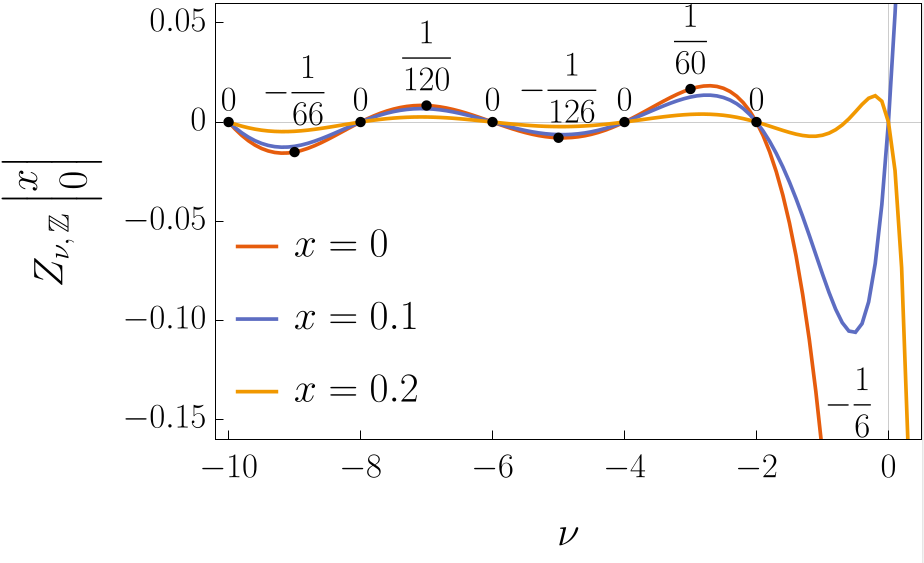
<p>You can actually see these trivial zeros \(-2, -4, -6\) of the Riemann zeta function in the plot of the blue line (Epstein zeta at \(x = y = 0\) and lattice \(\mathbb{Z}\) = two times Riemann zeta). Note that the Epstein zeta function shares these zeros for other values of \(x\) too!</p>

<p><img src="/images/2025-04-22-zetanuplot.png" alt="Plot of the Epstein zeta function" />
<em>Visualization of the one-dimensional Epstein zeta function as a function of the exponent \(\nu\) for \(y = 0\) and various values of \(x\). Created by the author. This image is licensed under a <a href="https://creativecommons.org/licenses/by-sa/4.0/">Creative Commons Attribution-ShareAlike 4.0 International License</a>.**Plot of the one-dimensional Epstein zeta function as a function of the exponent \(\nu\) for \(y = 0\) and various values of \(x\). Created by the author. This image is licensed under a <a href="https://creativecommons.org/licenses/by-sa/4.0/">Creative Commons Attribution-ShareAlike 4.0 International License</a>.</em></p>

<p>Interestingly, the Epstein zeta function isn’t just relevant to number theory (the research area where the Millennium Problem is situated). It also plays a crucial role in physics, particularly in systems involving sums over large numbers of particles. One notable example is the <strong>Casimir effect</strong>, which was predicted in 1948<sup id="fnref:4" role="doc-noteref"><a href="#fn:4" class="footnote" rel="footnote">4</a></sup> and later experimentally confirmed. The reason for this is quite technical; you might encounter it after about six semesters of studying physics, in an introduction to quantum field theory at university. Surprisingly, the calculation can be expressed in terms of the Epstein zeta function!</p>

<p>In short, the total energy \(\mathcal E\) between the plates is given by 
\[
\mathcal E(\Lambda) = \frac{1}{2} \sum_{\boldsymbol k} \lambda_{\boldsymbol k}^{-\nu}
\]
in the sense of evaluating the meromorphic continuation in \(\nu \in \mathbb C\) of the lattice sum at \(\nu = -1\). \(\boldsymbol k\) is a wavevector, and \(\lambda_{\boldsymbol k}\) are the eigenvalues of a massless Klein-Gordon equation (you can read about this in detail in our paper<sup id="fnref:5" role="doc-noteref"><a href="#fn:5" class="footnote" rel="footnote">5</a></sup>). The important bit: This can be expressed in terms of the Epstein zeta function as
\[
\mathcal E(\Lambda) = \pi Z_{\Lambda^{-T}, -1} \genfrac||{0pt}{0}{\boldsymbol x}{\boldsymbol y}
\]
as one can, among others, learn from the famous Steven Hawking<sup id="fnref:6" role="doc-noteref"><a href="#fn:6" class="footnote" rel="footnote">6</a></sup> and Stephen Wolfram<sup id="fnref:7" role="doc-noteref"><a href="#fn:7" class="footnote" rel="footnote">7</a></sup>, the latter being the founder of Mathematica, my favorite programming language, in which I created the visualization!</p>

<p>Here’s how it works: Imagine two perfectly conducting plates in a vacuum, placed extremely close to each other. Classical physics predicts that nothing will happen since it’s a vacuum. But in the realm of quantum physics, the opposite is true: quantum fluctuations cause an attractive force between the plates, effectively pushing them together. This result is truly surprising and counterintuitive, since intuition says that there is nothing in the vacuum to act on the plates! The underlying calculation involves advanced techniques, but at its core, it can be expressed using the Epstein zeta function. This is just one example of how my favorite special bridges the gap between abstract theory and real-world phenomena ✨</p>

<p>So, why does this matter for researchers in physics? Before our work, if someone wanted to calculate the Epstein zeta function for a specific physical scenario, they would likely have to sift through expensive, specialized books on lattice sums (such as this one<sup id="fnref:8" role="doc-noteref"><a href="#fn:8" class="footnote" rel="footnote">8</a></sup>), hoping to find a relevant case 😓 Now, we’ve solved this problem by developing a free, open-source software library<sup id="fnref:9" role="doc-noteref"><a href="#fn:9" class="footnote" rel="footnote">9</a></sup> that efficiently calculates the Epstein zeta function for any real parameter 🚀 In our preprint<sup id="fnref:5:1" role="doc-noteref"><a href="#fn:5" class="footnote" rel="footnote">5</a></sup>, we discuss the properties of this function and how it can be applied to a variety of physical systems.</p>

<p><img src="/images/2025-04-22-Epstein.png" alt="Paul Epstein" />
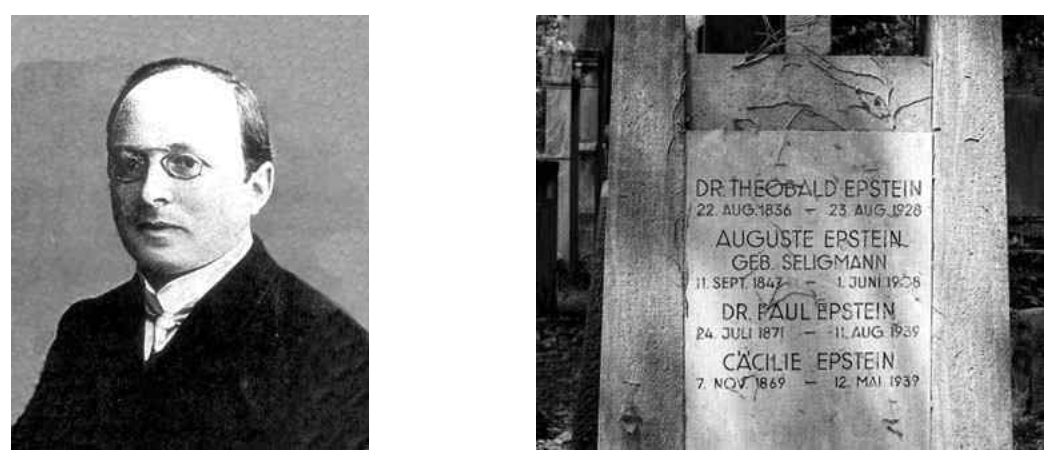
<em>Paul Epstein (1871–1939), the mathematician who derived the Epstein zeta function. Image source: <a href="https://mathshistory.st-andrews.ac.uk/Biographies/Epstein_Paul/">MacTutor History of Mathematics archive</a>, University of St Andrews, Scotland. This image is licensed under a <a href="https://creativecommons.org/licenses/by-sa/4.0/">Creative Commons Attribution-ShareAlike 4.0 International License</a>.</em></p>

<h2 id="references">References</h2>

<div class="footnotes" role="doc-endnotes">
  <ol>
    <li id="fn:1" role="doc-endnote">
      <p><a href="https://www.youtube.com/watch?v=d6c6uIyieoo">Riemann Hypothesis - Numberphile</a> “The most difficult way to earn a million dollars” <a href="#fnref:1" class="reversefootnote" role="doc-backlink">&#8617;</a></p>
    </li>
    <li id="fn:2" role="doc-endnote">
      <p>P. Epstein. “Zur Theorie allgemeiner Zetafunctionen”. In: Math. Ann. 56 (1903), pp. 615–644. url: https://doi.org/10.1007/BF01444309. <a href="#fnref:2" class="reversefootnote" role="doc-backlink">&#8617;</a></p>
    </li>
    <li id="fn:3" role="doc-endnote">
      <p>P. Epstein. “Zur Theorie allgemeiner Zetafunktionen. II”. In: Math. Ann. 63 (1906), pp. 205–216. url: https://doi.org/10.1007/BF01449900. <a href="#fnref:3" class="reversefootnote" role="doc-backlink">&#8617;</a></p>
    </li>
    <li id="fn:4" role="doc-endnote">
      <p>Hendrik BG Casimir. “On the attraction between two perfectly conducting plates”. In: Indag. Math. 10.4 (1948), pp. 261–263. <a href="#fnref:4" class="reversefootnote" role="doc-backlink">&#8617;</a></p>
    </li>
    <li id="fn:5" role="doc-endnote">
      <p>Andreas A Buchheit, Jonathan K. Busse, and Ruben Gutendorf. “Computation and properties of the Epstein zeta function with high-performance implemen- tation in EpsteinLib”. In: arXiv preprint arXiv:2412.16317 (2024). <a href="#fnref:5" class="reversefootnote" role="doc-backlink">&#8617;</a> <a href="#fnref:5:1" class="reversefootnote" role="doc-backlink">&#8617;<sup>2</sup></a></p>
    </li>
    <li id="fn:6" role="doc-endnote">
      <p>: Stephen W Hawking. 1977. Zeta function regularization of path integrals in curved spacetime. Communications in Mathematical Physics 55 (1977), 133–148. https://doi.org/10.1007/BF01626516 <a href="#fnref:6" class="reversefootnote" role="doc-backlink">&#8617;</a></p>
    </li>
    <li id="fn:7" role="doc-endnote">
      <p>Jan Ambjørn and Stephen Wolfram. 1983. Properties of the Vacuum. I. Mechanical and Thermodynamic. Annals of Physics 147, 1 (Aug. 1983), 1–32. doi:10.1016/0003-4916(83)90065-9 <a href="#fnref:7" class="reversefootnote" role="doc-backlink">&#8617;</a></p>
    </li>
    <li id="fn:8" role="doc-endnote">
      <p>J. Borwein et al. Lattice Sums Then and Now. Encyclopedia of Mathematics and its Applications. Cambridge University Press, 2013. url: https://doi.org/10.1017/CBO9781139626804. <a href="#fnref:8" class="reversefootnote" role="doc-backlink">&#8617;</a></p>
    </li>
    <li id="fn:9" role="doc-endnote">
      <p>https://github.com/epsteinlib/epsteinlib <a href="#fnref:9" class="reversefootnote" role="doc-backlink">&#8617;</a></p>
    </li>
  </ol>
</div>]]></content><author><name>Jonathan K. Hartlaub</name><email>contact@jkhartlaub.com</email></author><category term="epstein zeta" /><category term="mathematics" /><summary type="html"><![CDATA[The Riemann hypothesis does not hold for the Epstein zeta function, though the physical applications are abundant.]]></summary></entry><entry><title type="html">Reflections on APS Summit 2025: Quantum Breakthroughs and Epstein Zeta Function</title><link href="https://jkhartlaub.com/aps-summit-2025/" rel="alternate" type="text/html" title="Reflections on APS Summit 2025: Quantum Breakthroughs and Epstein Zeta Function" /><published>2025-03-23T00:00:00+01:00</published><updated>2025-03-23T00:00:00+01:00</updated><id>https://jkhartlaub.com/aps-summit-2025</id><content type="html" xml:base="https://jkhartlaub.com/aps-summit-2025/"><![CDATA[]]></content><author><name>Jonathan K. Hartlaub</name><email>contact@jkhartlaub.com</email></author><category term="linkedin" /><category term="conference" /><category term="quantum computing" /><category term="epstein zeta" /><summary type="html"><![CDATA[On healthy controversial discussions at this year's American Physical Society March Meeting.]]></summary></entry></feed>